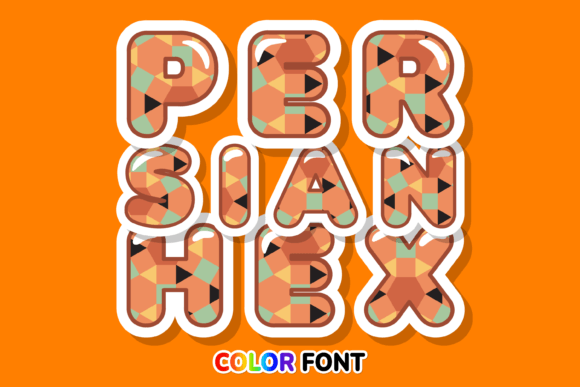
Persian Hex: A Color Font Built for Modern Web Design
Choosing the right typeface for a digital project often comes down to balancing personality with performance. You want something that stops the scroll, communicates brand tone instantly, and still reads well on a phone screen at two in the morning. Persian Hex is a color font that delivers on all these fronts. Its visual character sits somewhere between geometric precision and handcrafted warmth, making it a compelling option for web designers who need a display face with real presence.
Unlike standard fonts that rely on a single solid color, Persian Hex carries its own built-in color palette. That means every letterform arrives with dimension, texture, and a ready-made decorative effect. For digital creators working on landing pages, online stores, or brand identity systems, this eliminates the need to layer gradients or textures manually. The font does the heavy lifting, allowing you to focus on layout, spacing, and user flow.
What Makes Persian Hex Different from Standard Display Fonts
At first glance, Persian Hex reads like a modern display typeface with a handcrafted soul. The letterforms are neither purely serif nor script; they occupy a space between structured geometry and fluid, almost calligraphic strokes. This hybrid personality gives it an approachable yet sophisticated feel, ideal for brands that want to convey both creativity and reliability.
The color font aspect means the typeface includes multiple color layers within the font file itself. When you type in Persian Hex on a compatible platform, the letters appear with pre-designed color variation, shadow effects, or gradient-like transitions. This is especially useful for web design projects where you want bold typography without bloating the page with extra CSS or image files. The result is cleaner code and faster load times, a win for both user experience and site performance.
Persian Hex also carries a slight handmade quality. The edges are not perfectly rigid, and the strokes have natural variation in thickness. That human touch can make a brand feel more authentic, especially in crowded digital spaces where sterile, robotic typography often dominates.
Where Persian Hex Performs Best in Digital Layouts
Not every font works well in every context. Persian Hex shines brightest in short, high-impact placements where you want the typography itself to act as a visual asset. Think hero section headlines, call-to-action buttons, promotional banners, and decorative page titles. These are the spots where users form first impressions, and a distinctive display font like Persian Hex can make those impressions count.
In landing page design, the headline is often the first element a visitor sees. Using Persian Hex for that primary headline immediately signals that the brand has invested in its visual identity. It communicates care, creativity, and attention to detail. For a boutique online store, a coaching website, or a creative portfolio, that first impression can directly impact engagement and conversion rates.
Section headings are another natural fit. When you pair a decorative heading in Persian Hex with clean body copy, you create a clear visual hierarchy that guides the reader through the page. The font’s built-in color adds an extra layer of distinction, making each section feel intentionally designed rather than templated.
Short phrases, taglines, and logo text also benefit. Because Persian Hex is highly legible at medium to large sizes, it works well for brand lockups and hero text where you need a single line to carry the message. It is less suitable for long paragraphs or dense body copy, where a simpler sans serif font or serif font would serve readability better.
Practical Examples for Real Digital Projects
Imagine you are designing a landing page for a creative coaching business. The brand voice is warm, encouraging, and visually driven. Using Persian Hex for the main headline—something like “Design Your Next Chapter”—immediately sets the tone. The font’s color layers add depth without distracting from the message. Below it, you set the supporting text in a clean sans serif font like Inter or Work Sans. The contrast between the expressive headline and the minimal body copy creates a natural reading rhythm.
For an online boutique selling handmade ceramics, Persian Hex can anchor the hero banner. A line like “Handcrafted for Your Table” in the font’s signature color style reinforces the artisanal quality of the products. The font feels handmade, which aligns with the brand’s story. Below the fold, product descriptions stay in a neutral serif font for a more editorial, trustworthy feel.
On a course sales page, Persian Hex works well for module titles or pricing callouts. A line like “Enroll Now and Start Creating” in a bold color font draws the eye and creates urgency without needing a flashy button style. The font itself becomes the visual anchor.
Digital brand kits also benefit. When you design a set of social media templates, email headers, or slide decks, Persian Hex provides a cohesive typographic voice across formats. Because it is a color font, the look remains consistent whether you are placing it on a light background, a dark background, or over an image.
Readability and Responsive Considerations for Web Use
Any web design discussion must address how a font behaves across devices. Persian Hex is designed for display purposes, so its readability is strongest at medium to large sizes. On desktop screens, you can safely use it for headlines down to around 24 pixels. On mobile, you may want to keep it at 32 pixels or larger to preserve the color detail and letterform clarity.
When placing Persian Hex over images, choose backgrounds with sufficient contrast. The font’s built-in color layers can interact with busy backgrounds in unpredictable ways. A simple overlay, a dark gradient, or a solid color block behind the text ensures the letters remain crisp and legible. On light backgrounds, the font reads naturally and its color features stand out clearly.
For small buttons or secondary labels, Persian Hex may not be the best choice. The letterforms are detailed, and at smaller sizes the color layers can compress in ways that reduce clarity. Reserve the font for primary visual moments and let supporting fonts handle the microcopy.
Responsive layouts require checking how the font scales. Most modern browsers handle color fonts well, but always test across Chrome, Safari, Firefox, and Edge. If you use Persian Hex in a webfont format, verify that the color rendering is consistent across platforms. Some older browsers may fall back to a monochrome version, so have a backup plan that still looks intentional.
Font Pairing Strategies for a Balanced Digital Identity
No display font works in isolation. The best font pairing enhances both the decorative typeface and the body copy, creating a cohesive system that guides the user through the content.
Persian Hex pairs naturally with a clean sans serif font for body text. The contrast between an expressive, colored display face and a minimal, neutral sans serif creates clear visual hierarchy. The sans serif handles readability for paragraphs, captions, and navigation, while Persian Hex draws attention to the key messages. Popular pairings include Montserrat, Poppins, or Open Sans for a modern, approachable feel.
If you want a more editorial or sophisticated brand identity, try pairing Persian Hex with a serif font for body copy. A typeface like Playfair Display or Lora adds a classic, trustworthy tone that complements the handcrafted quality of Persian Hex. This combination works especially well for blogs, portfolio sites, and online magazines where reading experience matters as much as visual impact.
For a more playful or expressive brand, you could combine Persian Hex with a script font or handwritten font in small doses. However, avoid using too many decorative typefaces on the same page. One expressive font is usually enough. Let the rest of the typography provide structure and breathing room.
When building a brand identity around Persian Hex, establish clear rules for where the font appears. Use it for primary headings, logo text, and hero statements. Keep all secondary text, navigation, and body copy in a simpler supporting face. This consistency builds brand trust and makes the design feel intentional rather than chaotic.
Technical Notes on Licensing and File Formats for Web Projects
Before integrating Persian Hex into a client project or your own online store, verify the licensing terms. Commercial font licensing is essential for any web design work where the font will be used in a business context. This includes websites, landing pages, online shops, digital templates, and brand assets. If you are designing for a client, make sure the license covers their specific use case, including any subpages or marketing emails.
Check which file formats are included with your purchase. For web use, you typically need WOFF2 for modern browsers and WOFF for broader compatibility. Some fonts also include OTF or TTF files for desktop use in design software. If you plan to use Persian Hex in prototyping tools like Figma or Sketch, confirm that the software supports color fonts. Most modern design tools do, but older versions may render the color layers differently.
Also look into whether the font includes alternates, stylistic sets, or multiple weights. Some color fonts offer variations that let you switch between different color schemes or letter shapes. If Persian Hex provides these options, they can add flexibility to your logo design, editorial design, or social media graphics without needing separate font files.
Multilingual support is another factor. If your project targets an international audience, verify that Persian Hex covers the character set you need. Extended Latin, Cyrillic, or other scripts may or may not be included, depending on the version.
Finally, always test the font in your actual design environment before committing to it. Load it into your staging site, test it on real devices, and review how it performs under different lighting conditions and screen resolutions. A premium font like Persian Hex can transform a digital product, but only when it is used thoughtfully and with attention to the user’s experience across every touchpoint.